 You are here:
Where to Buy an Automatic Riveting Machine: Purchase Channels Compared
Where to Buy an Automatic Riveting Machine: Purchase Channels Compared
An automatic riveting machine is custom industrial automation equipment, not a standard power tool you can pick up anywhere. Buyers generally choose between four channels: the source factory, a regional distributor, a general e-commerce platform, and used equipment. Price, customization, after-sales support, and parts availability differ sharply between them. This guide compares all four and explains how customers worldwide can see and test a machine close to home.
Antec builds the three riveting lines separately, so general riveting, rivet nut fastening and blind rivet assembly each get equipment matched to the condition. The notes below look at automatic riveting machine work in that setting.
For manufacturing plants that rivet across several product types, the essentials: the four purchase channels compared; why the source factory should be your first call; how to see and test the machine; what to confirm before you buy.
1. The Four Purchase Channels Compared
| Channel | Strengths | Risks and drawbacks |
|---|---|---|
| Source factory | Non-standard customization, transparent configuration, long-term parts supply, installation and training included | You need to supply detailed specs, which takes some back-and-forth |
| Regional distributor | Fast local response and demo machines on hand | Markup on price; customization and deeper service still depend on the factory |
| General e-commerce platform | Easy price comparison and quick ordering | Mostly small standard models, with weak custom fitting and after-sales |
| Used equipment | Low upfront cost | Fixed specs that rarely match, no warranty, and hard-to-find nosepieces and feed-track parts |
Standard models cover most jobs, and the exceptions are where the engineering team earns its keep.
2. Why the Source Factory Should Be Your First Call
The value of an automatic riveting machine comes down to three things: matching the rivet spec, stable feeding, and long-term parts. Feed tracks, nosepieces and fixtures are usually built around the customer's own rivet, which a distributor's or an online seller's standard machine rarely covers. The equipment is expected to run for many years, so ongoing supply of nosepieces and wear parts, plus setup support, matters more than the purchase price. Buying direct from the source factory removes the middleman markup: standard machines sell at factory-direct prices, non-standard work is quoted item by item, and the factory carries the warranty and the training itself.
Antec has spent 16 years developing and building automatic riveting machines as a source manufacturer. We have delivered 3,296+ riveting solutions and served 1,300+ enterprise customers. The lineup covers automatic riveting machines, auto-feed rivet nut guns, auto-feed rivet guns and robotic riveting cells. Every machine carries a 1-year warranty, a 7-day return and 15-day exchange for non-human damage, and wear parts at cost on long-term supply.
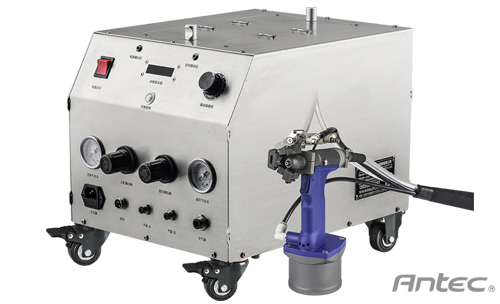
3. How to See and Test the Machine
Antec's manufacturing base is in Huizhou, Guangdong, and we serve manufacturing regions worldwide. Customers can see and validate a machine in two ways:
Option 1: Book an on-site trial. Send us your rivet specs and part information, and an engineer brings a matching machine to your plant to run your own rivets and workpieces, measuring cycle time, pull force and yield. A standard on-site trial is free, and we respond within 1 working day of your request.
Option 2: Send samples for a sample run. Ship rivet samples and typical parts to our manufacturing base. Our shop runs the samples and sends back video and measured data; once you approve the results, we schedule shipment and on-site installation and commissioning.
Across three lines, the fastest route is usually to match the working condition first and the model second.
4. What to Confirm Before You Buy
| Item to confirm | What to check |
|---|---|
| Supplier type | Manufacturer or trading company, and whether they can provide factory and case-study material |
| Spec compatibility | Written confirmation of the head diameter, body diameter and length range the machine handles reliably |
| Quotation structure | Whether tax, freight and installation training are included, and whether non-standard items are listed separately |
| Warranty and parts | Warranty term, return and exchange conditions, wear-part prices and supply lead times |
| Trial arrangements | Whether they bring a machine to you or run samples, so you can decide on measured data |
5. What to Send in One Go When You Request a Quote
The more complete the information you give a manufacturer, the more accurate the proposal and the less room there is for vague pricing. Put the details below together and send the same package to 2-3 suppliers for comparison:
| Information | Details |
|---|---|
| Rivets | Type, head diameter, body diameter, length, material and daily consumption |
| Workpiece | Drawing or photo, material and thickness, number of rivet points and their spacing, annual volume |
| Cycle time | Current manual cycle, target time per part, shift pattern |
| Site conditions | Air supply parameters, workstation space, whether the machine must connect to a line or robot |
| Commercial | Required lead time, delivery location, whether installation training is needed, and the invoice type |
When the replies come in, compare the written spec commitment, the trial offer, the warranty and parts terms, and how transparent the line-item pricing is, rather than the total price alone. Antec turns that information into a proposal and price range in about 10 minutes and can arrange an on-site trial.
Common Questions About Buying Channels
Common Questions
Cheap machines usually cut corners on the feed mechanism, the cylinder and the electronics. They jam more often and come with no parts support. A riveting machine is long-term production equipment, so factor failure rate, warranty and parts supply into any price comparison.
Antec works by appointment: an engineer brings a machine to your plant and runs your parts. That proves far more about real workpiece results than watching a demo unit at a showroom.
Standard models for common rivet specs ship straight from stock. If your rivet is unusual, or the rivet points and part shape impose specific requirements, the machine has to be customized. Send your specs and we can usually tell you within about 10 minutes whether a standard model will do the job.
A preliminary proposal, a price range and an on-site trial should not depend on a deposit. Deposits normally follow proposal approval and contract signing, paid against milestones. Be cautious with any supplier that demands full payment before a trial or refuses to put the compatible spec range in writing.
Automatic Riveting Machine at a glance: 12,800 N pull force, 80 cycles per minute, in stock for fast delivery, response within 5 minutes.
Antec has served more than 1,300 manufacturing enterprises with selection, non-standard customization, free on-site trials and after-sales training.
Which of the three lines fits this job?
Send the rivet specification and the workpiece drawing. Antec engineers will name the line, the model and the price band, then arrange a free on-site trial.
Further reading: About Antec · Automatic Riveting Machine Buying Guide (full series) · Manufacturer
 Previous